SXSW lit up Shoreditch for its second year, bringing thousands of curious, opinionated people into the same postcode and the kind of creative friction that only happens in person.
An undeniable buzz of excitement, the energy across the open spaces left attendees no choice but to be hopeful; in their industries, in their ability to connect with others, in their absorption of ideas and experiences, beyond the usual conference or festival.
The dominant theme was not surprising in volume, but surprising in polarisation.
AI, arguably the buzzword of the decade with real weight behind it, saturated every dimension of the programme. From brand activation stands in the Truman Brewery Expo to keynote speeches and opening remarks, and panel discussions on its implications across a spectrum of topics such as identity, sport, creativity, events, and the future of how we will work together in this new age. 20+ session titles within the first couple of days featured the word ‘AI’. However, what was more revealing was the range of positions people took, and how unresolved the conversation remains – as maybe it should be.
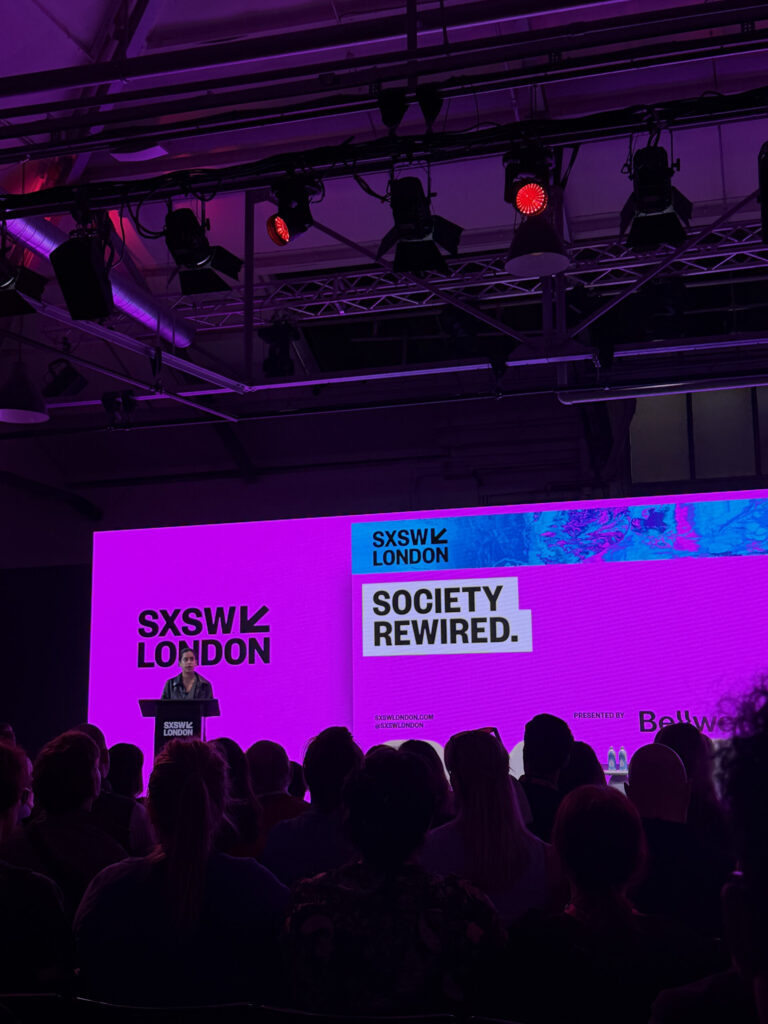
The SXSW AI presence as observed through three lenses:
- AI as Performance Infrastructure
Sessions like Beyond the Logo: How Technology Drives Competitive Advantage for Formula 1 by the CEO and team from Oracle made the case most empirically. Drawing on Formula 1 as a case study, the session argued that AI, when embedded into organisational culture rather than bolted on as a feature, creates durable competitive advantage. Real-time data, predictive decision-making, and machine learning are not separate from the sport; instead, they are the sport. The implication for brand strategy was direct: the question is not whether to adopt AI but how deeply it runs through your operating logic.
This framing positioned AI as a form of institutional infrastructure, similar to how financial services integrated algorithmic trading or how logistics adopted route optimisation. The technology becomes invisible not because it disappears, but because it becomes load-bearing to the process.
- AI as a Creative Workflow
The CapCut AI workshop took a more hands-on angle. Framed as a live showcase and interactive demonstration, the session explored how AI is restructuring the creative process, compressing the distance between concept and execution in ways that free up space for the thinking that actually matters. The argument was not that AI replaces craft but that it absorbs the mechanical, leaving the human to operate at a higher register.
This is a meaningfully different proposition from replacement. It suggests that the value of human creative input is not in the execution of known processes but in the judgment, instinct, and taste that determine which direction to go in the first place.
- AI as an Identity Pressure
Rewiring the self, moderated by Lucie Cave, Chief Creative Officer of Bauer Media, offered the most cautionary framing. The session explored how digital overwhelm, creative multi-hyphenation, and the pace of technological change are quietly reshaping human identity, asking not just what we are gaining from AI but what we may be losing. From burnout to the erosion of deep focus, the session situated AI within a broader societal shift that requires new frameworks for understanding ourselves, our work, and our purpose.
This was the tension the rest of the festival struggled to resolve. Technology can compress time, expand capability, and lower both the cost of and entry barrier to creation. But the question of what you create, and why, and for whom, remains very human.
THE CENTRAL TENSION
AI, and then what?
AI was either the protagonist, the antagonist, or the throwaway punchline in nearly every room, rarely a neutral narrative device. Veering from championing the change, right into keeping it in check, was jarring to say the least. Arguably, however, the neutral naturalised sentiment pushes the conversation forward more meaningfully
The conversations were more nuanced than the headlines suggest. The spectrum ran from deep anxiety about displacement and the next generation grappling with tools for their future to genuine excitement about creative expansion, higher ROIs, and endless new optimisation opportunities. Yet, the most productive moments were those that refused to collapse into either position, instead looking beyond to determine, once the tangible AI outcomes are produced, how we can maintain integrity and the general human experience.
The analogy used in one of the talks that struck me was how the AI tools of today are a parallel to the stone age tools and what we make of them. A deeper parallel is the AI age, the Dot Com boom, and the industrial revolution – all of which evoked some anxiety of human futility, until eventually platforming human input as most valuable, with these tools as equal-playing-field vehicles of creativity.
THE HUMAN MOMENT
“Why Creativity Needs a Seat at the Adult’s Table”
The session that landed with the most lasting resonance was delivered by David Lee, Chief Brand and Creative Officer at Squarespace. The premise was direct: creatives are too often told to sit at the kids’ table and leave the business to the adults. His argument, built from a decade of growing Squarespace from a start-up into a public company with a globally recognised in-house creative function, was that this is both a strategic error and a category mistake.
Creativity is not simply a bolt-on decoration or something to be retrofitted into rigid ROI frameworks. It is a competitive differentiator that operates and impacts level of positioning, perception, and cultural relevance. The creative team that built Squarespace into one of the most-awarded in-house agencies in the world did so not by being more aesthetic, but by being more strategically integrated. The lesson for creatives is to move upstream, to speak the language of business without automating the instincts that make creative work valuable.
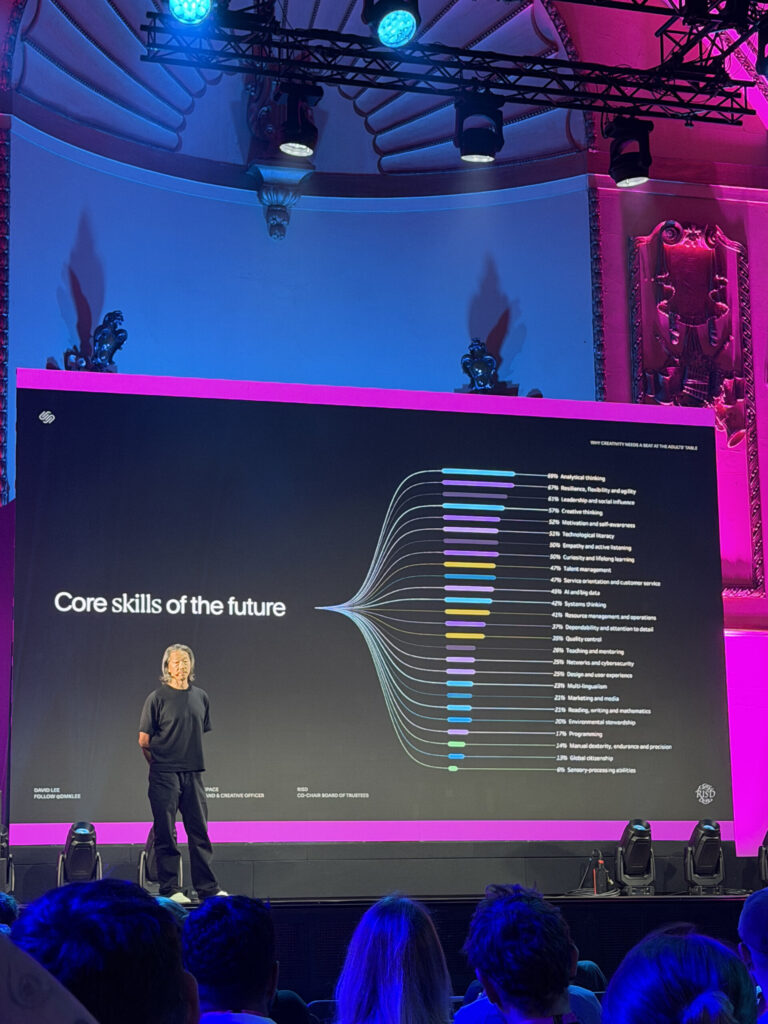
The most valuable thing about human creative instinct is not that it is fast or efficient. It is that it knows when to stop. – David Lee
In the context of an AI-saturated programme, this session felt like a direct answer to the question the rest of the festival was circling. The cost-saving mindset, the private equity playbook, and the narrow short-term metrics are the real threat to creative culture. If AI absorbs execution, then the creative who survives is the one who can operate at the strategic level: setting direction, making cultural judgment calls, knowing what the tools cannot know, and above all, taste.
The Shoreditch Contrast
The most clarifying moment of the festival came not from a session but from stepping outside one. Alex Mahon, CEO of Superstruct Entertainment – one of the world’s leading festival groups that operates over 80 festivals across 10 countries, touched on this in her Rewiring Connection: Why Festivals Matter More Than Ever. Shared spaces are shrinking, and communities are fragmenting, and festivals, she argued, cut through that.
The formal programme, with its timed panels, brand activations, and sponsored stages, was doing important work. But the energy that felt most alive was in the streets outside the cold AI dissection confined within walls: a live set in a basement venue, a conversation that spilled out of a session and kept going over lukewarm coffee, the sense of being in a particular room at a particular moment with people who chose to be there with intent – this was the real reenergizing soul of SXSW London.
That tension, between the relentlessly digital conversation inside the venues and the soulful human experience just outside them, was the whole festival in a sentence. SXSW London did not resolve the debate around AI, and it definitely was not designed to. What it did was put the right people in a room together and let the friction do its work and come to light.
And there is something instructive in that for the experiential space. The most valuable output of a festival is not the content that was delivered and the efficiency of generated speeches; it is the thinking that gets activated in the gaps between sessions, in the conversations that form organically, in the coming together of perspectives that only happens when you are physically present in the same place as someone you would never otherwise meet – and where you go next.
STRATEGIC IMPLICATIONS – what does this mean for the experiential industry?
Several threads from SXSW London converge into actionable positions for brands and cultural organisations operating in the current environment.
Human input is the scarce resource
As AI absorbs execution, the value of genuine human judgment, taste, cultural instinct, and strategic creativity increases rather than decreases. Organisations that treat creative and strategic human input as a cost to be optimised are misreading the competitive landscape.
Technology advantage is cultural, not just technical
The Formula 1 case study was instructive not because of the technology but because of the culture that allowed the technology to run deep. The same tools are available to all teams. The differentiator is the institutional willingness to let them matter. This applies directly to brand strategy.
Authenticity is upstream of activation
The UK creative export conversation reinforced a principle that applies beyond Britain and is an objective truth across industries: the most transferable cultural assets are those with genuine attribution. AI can amplify and distribute, but it cannot manufacture origin or authenticity. Brands that invest in building real cultural depth will outperform those that use AI to simulate or Frankenstein-style replicate it.
Creative leaders need to operate at the business level
David Lee’s argument at Squarespace is a playbook for the current moment. The creatives who will thrive in an AI-augmented environment are those who can move upstream, demonstrate strategic value, and make the case that creativity is not a service function but a competitive capability that sets you apart from Uncanny Valley patterns and soulless near-replicas.
Physical presence still produces something irreplaceable
In a world of infinite digital content, the experience of being in a room with real people, navigating live energy, and making unscripted connections remains a high-value proposition regardless. Experiential strategy should lean into this rather than compete with or surrender to plug-and-play AI propositions and static stands. People will always glance beyond the screen, regardless of how pretty the digital can be.
No algorithm curated what it felt like to be standing in that room. That is not a criticism of AI, but it is definitely a stark reminder of what cannot be replicated or automated, but could always be elevated and innovated- Yara Alem, Strategist, MCH Global